Kairasi - A legacy of trust since 1929|Bespoke Solitaire Jewellery in 72 hours|24 Carat:  505.00|22 Carat:  467.75|18 Carat:  384.25
N Gopaldaas Jewellers
  • Diamonds
    • Bangles
    • Bracelet
    • Necklaces
    • Nosepin
    • Pendant
    • Rings
    • Earrings
    • Bridal
    • Muggapu
  • Gemstones
  • Collections
    • Navaratna
    • Polki
  • Bespoke
  • MOND
0
  • Home
  • Gemstones
  • What Makes a Stone Require a High-Value Gemstone Certificate

What Makes a Stone Require a High-Value Gemstone Certificate

Summary: A concise guide to Dubai’s gemstone certification landscape, covering DCL reports, DGC services, sample transport rules, local versus overseas options, and certificate verification.
Picture of Darshan Shah

Darshan Shah

  • September 29, 2026
Facebook X-twitter Youtube
  • Quick Answer / Key Takeaways
Quick Answer: A gemstone requires a high-value certificate when its colour grade, origin claim, or treatment status is tested against the price being asked. An international certificate is also required when a seller charges a high price for rare gems.
  • Key Takeaways:
  • Three claims commonly require an international laboratory report: exceptional colour grade, rare origin, and untreated status in categories where treatment is common.
  • Named colour grades such as Royal Blue, Pigeon Blood Red, and Vivid Green require laboratory verification.
  • Origin premiums for Kashmir, Burma, Colombia, and Paraíba depend on lab-confirmed origin.
  • Testing can support treatment conclusions, but laboratories can disagree; a certificate is an expert opinion, not absolute fact.
  • A local certificate is enough for most commercial or astrological stones.
  • Table of Contents
  • 1. What Is Gemstone Certification?
  • 2. When Does Exceptional Colour Require a High-Value Certificate?
  • 3. When Does Exceptional or Rare Origin Require Certification?
  • 4. When Does No Treatment Require a High-Value Certificate?
  • 5. When Is a Local Certificate Enough?
  • 6. Practical Guidance for Buyers and Sellers
  • 7. Conclusion
  • 8. Frequently Asked Questions

1. What Is Gemstone Certification?

A certificate is a document that declares what kind of gem the stone is. It states whether it has been treated and, in some cases, where it came from.

When a gem has an exceptional grade, it is the custom in the trade to refer to an international laboratory certification from an accepted laboratory. However, in the case of everyday stones, a local certificate will suffice. The difference between a local and international certificate is the authority behind the signature and the equipment that supports it.

Info Box: Local vs. International Certificate

A local certificate can identify a stone and note whether it has been treated. An international laboratory certificate carries greater authority for premium claims such as exceptional colour, rare origin, or untreated status.

2. When Does Exceptional Colour Require a High-Value Certificate?

Certificate?

Colour has the biggest impact on a gem’s value because some shades are so rare, they have acquired special designations in the trade. Some rare gems include Royal Blue sapphires, Pigeon Blood Red rubies, and Vivid Green emeralds.

Named Colour Grades That Require Laboratory Verification

These named colour grades are not everyday descriptions. They are trade designations that can significantly affect price.

Examples include:

  • Royal Blue sapphires
  • Pigeon Blood Red rubies
  • Vivid Green emeralds

Why Pigeon Blood Red Can Differ Between Laboratories

The case is different for the Pigeon Blood gemstone. It was popularised by GRS in the 1990s, but other laboratories have had their own take on the grade. As a result, two certificates on the same ruby might have two different interpretations of the grade.

How Certification Supports a Colour Premium

In order to confirm that a stone is of an exceptional grade, it will need to be appraised by an international laboratory. This will confirm the grade, and the stone will be able to command a premium for the exceptional grade.

3. When Does Exceptional or Rare Origin Require Certification?

Origin can add significantly to a gem’s value. Kashmir sapphires, known for their velvet blue colour; Burmese rubies, famed for their beautiful red colour; Colombian emeralds, which have a vivid green hue; and Paraíba tourmalines, which have a neon-like quality, are highly prized in the trade.

Premium Origins in the Trade
The following origins often carry a premium:

  • Kashmir sapphires
  • Burmese rubies
  • Colombian emeralds
  • Paraíba tourmalines

How Laboratories Determine Origin

As is the case with colour, origin needs to be certified by an international laboratory. Cutting-edge lab equipment can confirm whether a stone is from a premium location.

Kashmir sapphires, for example, have distinctive inclusions and trace elements that set them apart from Sri Lankan or Madagascan sapphires.

Why Origin Certification Gives a Claim Weight

It is this certification that allows a gem from a premium location to fetch a premium price. If a seller is claiming that a gem is from a premium location, the certificate is what gives the claim weight.

Highlight: A rare origin claim without an accepted laboratory report may not justify a premium price.

4. When Does No Treatment Require a High-Value Certificate?

Many gems are routinely treated to enhance their beauty: sapphires are heat-treated to improve their colour, rubies are filled to improve their clarity, and emeralds are oiled to make them less prone to breakage.

Treatments That Create a Premium for Untreated Stones

When a gem is found to be untreated, it can command a premium price. This premium only has value if it can be documented that the gem is indeed untreated.

Examples of treatment-sensitive categories include:

  • Unheated sapphires
  • Unfilled rubies
  • Unoiled emeralds

What Only an International Laboratory Can Confirm

Only an international laboratory can confirm that a sapphire is unheated or that an emerald has not been oiled. A local certificate can identify a stone, but not with the degree of precision needed to document that it has not been treated.

Limits of Treatment Testing

Certification processes have one problem: laboratories can disagree about what they consider to be treatment and what they consider to be nature. Especially with sapphires and low-temperature heating, a laboratory might find a stone to be unheated while another will find that it has been heated.

Expert Insight: A certificate offers an expert opinion, but it is not an absolute statement of fact.

5. When Is a Local Certificate Enough?

Not every stone needs a certificate from an international laboratory.

Best Uses for Local Certificates

  • For commercial stones, a local certificate will be enough to identify the stone, note its qualities, and note whether it has been treated.
  • A certificate from an independent laboratory will be enough for most buyers and most sellers for most commercial or astrological stones.

Rule of Thumb: If the stone is commercial or astrological, and the price does not depend on a rare colour grade, rare origin, or untreated status, a local certificate is usually sufficient.

6. Practical Guidance for Buyers and Sellers

For Buyers: Match the Certificate to the Claim

To a buyer, the question is: What is the claim?

  • Identify the claim being made about the stone.
  • If the claim is about origin, colour grade, or lack of treatment, the report will need to come from an international laboratory accepted as an authority on that particular issue.
  • Check that the certificate actually supports the price being asked.

For Sellers: Avoid Over- and Under-Certification

To a seller, the question is: Does the certificate match the claim?

  • Confirm what claim the sale depends on.
  • Get the right certificate for that claim.
  • Avoid spending money on a certificate that the sale does not require.
  • Avoid under-certifying a stone that requires a certificate to justify the price.

Certificate Match Matrix

Claim or Use CaseRecommended CertificateWhy
Commercial or astrological stone identificationLocal/independent laboratory certificateIdentifies the stone, notes qualities, and notes whether it has been treated
Exceptional colour grade: Royal Blue, Pigeon Blood Red, Vivid GreenInternational laboratory accepted for that gradeConfirms named grade and supports premium
Rare origin: Kashmir, Burma, Colombia, ParaíbaInternational laboratory accepted for originConfirms premium origin and gives the claim weight
Untreated status in commonly treated categoriesInternational laboratoryDocuments unheated sapphire or unoiled emerald with precision

Highlight: The certificate should match the claim. Over-certification is a waste of money, and under-certification can leave the value of a stone in question.

7. Conclusion

A certificate reflects a price claim. When a stone is claimed to have an exceptional colour grade, a rare origin, or to be untreated, it means that the seller is claiming that the stone has attributes that cannot be evaluated by the buyer. In these cases, an international laboratory report will substantiate the claim and justify the price.

For commercial or astrological stones, a local certificate will suffice. The rule of thumb in the trade is that a certificate should match the claim.

By certifying a stone’s attributes, origin, and lack of treatment, the laboratory is offering an expert opinion. This might not always be an accurate opinion, as different laboratories can have different standards for defining colour grades and treatments, but it is an authoritative opinion.

Gems that command a premium should have the sort of certificate that will justify the premium. Over-certification is a waste of money, and under-certification can leave the value of a stone in question.

Quote: “A certificate reflects a price claim.” – Darshan Shah, Gemmologist

8. Frequently Asked Questions

What makes a gemstone require a high-value certificate?

The price must be based on a claim that an appraiser cannot confirm by eye. If a seller is charging a premium for Kashmir but does not have a report from an accepted laboratory that determines origin, the premium is unwarranted.

Which gemstone qualities need international laboratory verification?

Qualities that need international laboratory verification are those that have received special designations: Royal Blue, Pigeon Blood Red, and Vivid Green; rare origins such as Kashmir, Burma, Colombia, and Paraíba; and untreated stones in categories where it is the norm for a stone to be treated.

Are local gemstone certificates enough?

They will be enough for most commercial or astrological stones. Local certificates will identify a stone and note its qualities and whether it has been treated.

Why do untreated gemstones need certification?

Many stones are treated. Untreated stones are rare. Certification is necessary to show that a stone has not been treated. Only an international laboratory can certify that a sapphire has not been heated or that an emerald has not been oiled.

What Makes a Stone Require a High-Value Gemstone Certificate

Quick Summary   Parts 1 to 3 covered the philosophy, the three triggers, and what the Jyotish tradition requires. This final part gives you the practical tools. An honest overview of the main laboratories. A stone-by-stone reference guide. Keep it. Use it.

We have covered the philosophy and the triggers. Now for the practical tools. Below is an honest overview of some of the main laboratories your certificate might come from — what each one is genuinely good at, and where it sits in the overall picture. Below this list is a reference guide to help determine certificates you can request/expect when buying a particular stone.

The laboratories — what each one is and where it fits

LabSpecialises InWhat Makes It RelevantLocationAuthority Level
GIADiamondsGold standard for diamonds. Origin reports for coloured stones on select high-value pieces only.InternationalHigh
IGIDiamonds + coloured stonesWidely accepted in UAE and India. Practical for mid-range diamonds.Dubai lab availableModerate
HRDDiamonds + coloured stonesBelgian institute. Credible and widely accepted in Europe, India and the UAE. Good for diamonds and standard coloured stones.InternationalModerate–High
GRSColoured stones onlyPioneered ‘Pigeon Blood’ and ‘Royal Blue’ colour grades. Preferred by auction houses.InternationalHigh
Gübelin Gem LabColoured stones + diamondsMost respected for origin determination on high-value coloured stones.InternationalVery High
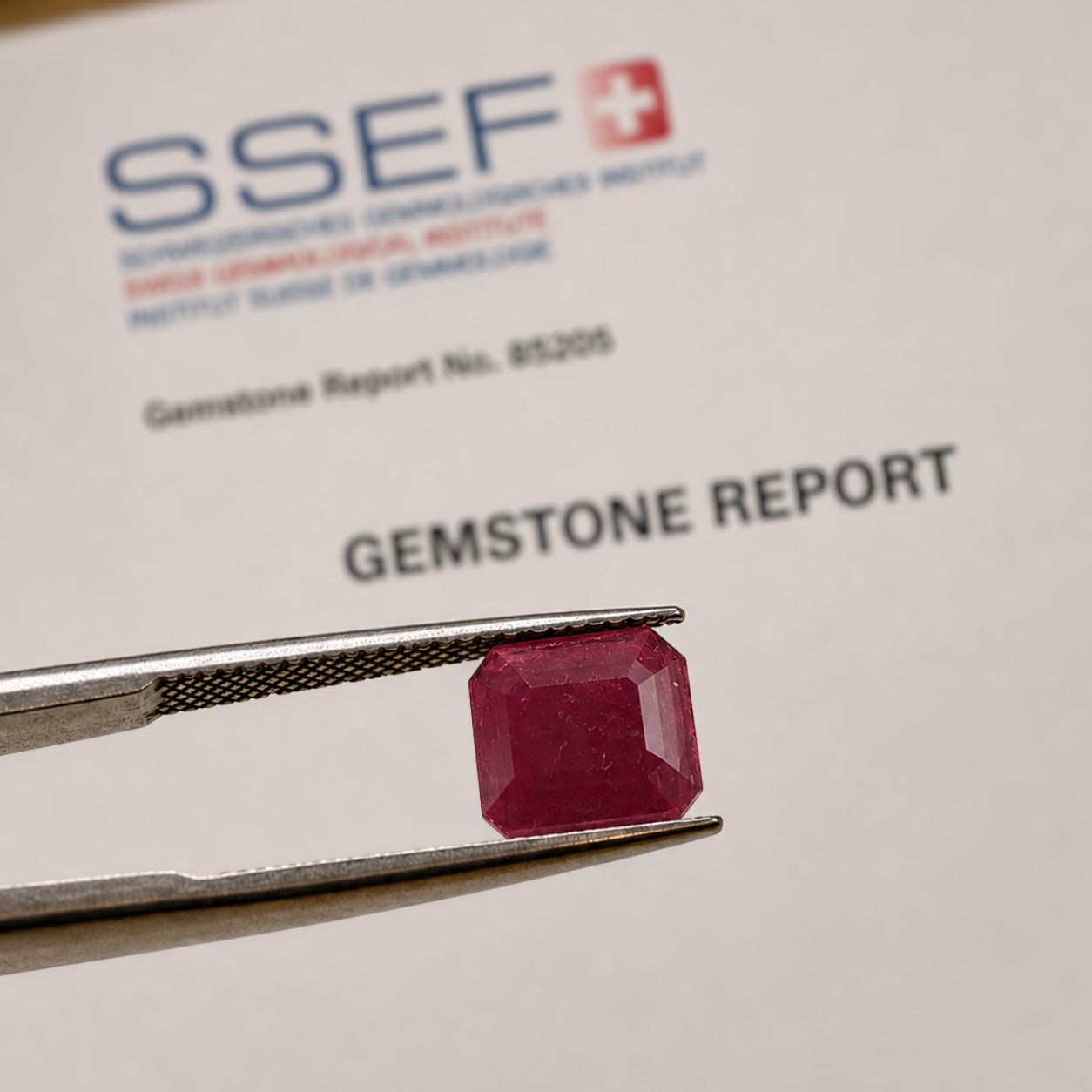
SSEFColoured stonesParticularly strong for emerald origin. Preferred by European collectors.InternationalHigh
DCL DubaiDiamonds + coloured stonesGovernment-backed. ISO-accredited. Legally recognised in the UAE.DubaiGood for the UAE market
IGTL JaipurColoured stones + diamondsReputable Indian lab. Reliable for identification and treatment disclosure.IndiaGood for the India–UAE market
GII MumbaiColoured stones + diamondsOne of India’s oldest gemological institutions. Well regarded across India and the Gulf.IndiaGood for the India–UAE market
Pangem, PuneColoured stonesRespected Indian lab. One of the few that photographs inclusions directly on the certificate — a unique identity record for the stone.IndiaGood for the India–UAE market
A note on the Dubai Central Laboratory DCL is a government-backed institution, accredited under ISO standards, and legally recognised across the UAE. It is a credible and capable laboratory for routine gemstone identification and basic treatment disclosure — comparable in standard to reputable Indian labs like IGTL Jaipur and GII Mumbai. It is not a global colour-grading authority on the level of the Swiss labs. But for the vast majority of purchases made by buyers in Dubai — including most astrological gemstone purchases — a gemstone certificate in Dubai issued by DCL is entirely fit for purpose.

Matching the certificate to the stone — Which gemstone certificate do I need?

Use this as your reference guide before any significant gemstone purchase. However, we recommend connecting with us to ensure the credibility of a specific laboratory for a certain precious stone. Do reach out to us to verify and validate before your purchase.

Stone Type and SituationRecommended CertificateWhy
Astrological gemstone (Neelam, Pukhraj, Panna, Manik) — standard qualityDCL Dubai, IGTL Jaipur, GII Mumbai, or Pangem PuneConfirms natural identity and treatment status. Proportionate to purpose and value.
Diamond — any valueGIA, IGI, or HRDGIA for high-value. IGI and HRD widely accepted in UAE and India for mid-range.
Coloured stone — good quality, typical origin, standard colourDCL Dubai, IGTL, GII, or IGISufficient for identification, treatment disclosure, and buyer confidence. However, for higher value coloured gemstones, you may need specific certifications, like those mentioned below.
Natural Blue Sapphire — Royal Blue or Cornflower Blue colour gradeGRS or GübelinThe colour grade on the certificate materially affects the value of the stone.
Natural Ruby — Pigeon Blood colour, possible Burmese originGRS or GübelinOrigin and colour grade together determine the premium. Both must be documented.
Colombian Emerald — no treatment or minimal treatmentGRS, Gübelin or SSEFUntreated Colombian emerald is rare. A credible certificate protects and proves that rarity.
Kashmir Sapphire — any qualityGRS, Gübelin or SSEFKashmir origin alone commands a significant premium. Must be verified by a top-tier laboratory.
Any exceptional stone — auction, inheritance or investment purchaseGRS, Gübelin or SSEFThe more irreplaceable the stone, the more important the documentation.

What this means in practice for determining which gemstone certificate I need?

If you are buying a gemstone for astrological purposes in the range most buyers operate in, a certificate from the Dubai Central Laboratory, IGTL Jaipur, GII Mumbai, or Pangem Pune is not a compromise. It is the right document for that purchase. It confirms what you need confirmed, it protects your ownership, and it does not cost more than the stone it accompanies.

This is the core answer to which gemstone certificate do I need in everyday buying situations.

If you are buying a stone that is exceptional in its category — exceptional colour, exceptional origin, exceptional treatment status — then the certificate matters more. Not because the stone is expensive, but because the certificate is the only thing that verifiably distinguishes it from a similar-looking stone that is not exceptional. In that case, the additional cost of a Swiss or GIA certificate is not overhead. It is part of what you are buying. Moreover, many sellers often provide more than one certificate for the same stone when it is an exceptionally rare gemstone that is under consideration.

The difference between these two situations is not always obvious to a buyer walking into a store. It is obvious to a gemologist who has been handling stones for 30 years. Which is exactly why the conversation matters.

A certificate does not make a gemstone valuable. It proves why it is.
A proportionate certificate from a credible laboratory protects both buyer and seller. Over-certifying wastes money. Under-certifying leaves value unverified.
What is a gemstone certificate actually telling you? A plain-language guide to reading every line of a lab report — from treatment disclosure codes to origin statements to colour grade terminology. The guide most buyers never get.

FAQ

Is a GIA certificate always better than IGI or HRD?

For diamonds, GIA is the most widely respected globally. IGI and HRD are credible and widely accepted in the UAE and India — often more practical for mid-range diamonds due to faster turnaround and lower cost. For coloured gemstones, none of the three is the first choice — the Swiss labs (GRS, Gübelin, SSEF) carry more weight for high-value coloured stones. However, when dealing in exceptionally rare stones, one may be provided more than one certificate to confirm authenticity.

Is a Gemstone certificate in Dubai reliable?

Yes — within its scope. A Gemstone certificate in Dubai issued by the Dubai Central Laboratory is ISO-accredited, government-backed, and legally recognised under UAE federal law. It is credible for routine gemstone identification and treatment disclosure, comparable to reputable Indian laboratories. It is not a global colour-grading authority for exceptional stones, but for the majority of purchases in the Dubai market it is entirely fit for purpose.

What makes a Colombian Emerald need a better certificate than other emeralds?

Because an untreated or minimally treated Colombian Emerald is exceptional within a category where treatment is the global norm. That rarity has real value — but only if it is verified by a laboratory whose treatment disclosure methodology the market trusts. A high-level certificate in this case is not about the price of the stone. It is about documenting something genuinely rare. In such cases, determining which gemstone certificate do you need becomes critical, and a basic report is not sufficient.

Can I get a gemstone certified in Dubai?

Yes. The Dubai Central Laboratory offers certification services for diamonds and coloured gemstones. IGI also has a laboratory in Dubai. For stones requiring Swiss-level certification, the stone would need to be sent abroad, which takes additional time and cost. At N Gopaldaas Jewellers we can advise you on the appropriate certificate for your specific stone and purchase.

What is the difference between GII Mumbai and IGTL Jaipur?

Both are reputable Indian gemological institutions. GII (Gemological Institute of India) is one of India's oldest, based in Mumbai. IGTL is based in Jaipur — the heart of India's coloured gemstone trade. Both are credible for identification and treatment disclosure for astrological gemstone purchases.

Why use Pangem Pune for certification?

Pangem is a respected Indian laboratory with strong credibility in the India–Gulf market. It is one of the few laboratories that photographs inclusions directly on the certificate, providing an additional layer of stone identity documentation — particularly valuable for astrological gemstones, where the stone's identity over time matters as much as its initial quality.

Darshan Shah, D.G., F.F.I.G. Darshan Shah holds a Diploma in Gemology from the Gemological Institute of India (GII) and is a Fellow of the Forum of Indian Gemologists (FFIG). He is Partner and Dubai Head of N Gopaldaas Jewellers, a 4th-generation family business founded in 1929 in Trichy, Tamil Nadu. First visiting Dubai in 1999 and relocating in 2012, Darshan has spent 30 years in the business. The business operates its own in-house manufacturing unit in Trichy and specialises in natural diamond and gemstone jewellery, bridal and bespoke creations, and astrological gemstone sourcing. Karama, Dubai | info@ngopaldaas.com | +971 4 3797950 | ngopaldaas.com
author avatar
Darshan Shah
See Full Bio

We at N Gopaldaas Jewellers tap into the mind and heart of every generation and create masterpieces that they would love to adorn for life !

Shop

  • Bangles
  • Bracelets
  • Necklaces
  • Nosepin
  • Pendant
  • Rings
  • Earrings
  • Bridal
  • Muggapu

Quick Links

  • About Us
  • The Work Shop
  • Sharada Band
  • Certified Jewellery
  • The 4Cs of A Diamond
  • Blogs
  • Store Locator
  • Contact Us

Help

  • Privacy Policy
  • Buyback Policy
  • Terms & Conditions
  • Shipment Policy
  • Exchange Policy
  • Faqs

Newsletter

Sign up for industry alerts, deals, news and insights from us.

©2026 N Gopaldaas Jewellers, All Rights Reserved.

Log in

Forgot Password
Register

Create Account

Already Has An Account

Forgotten Password?

Already Has An Account
Create Account Forgot Password
London, Hyde Park Streetno 21
Choose Shipping medthod is Pickup Store on Cart page!
Choose a store for picking up your order on the Checkout page.
Close

Shopping Cart

No products in the cart.