
Quick Answer:
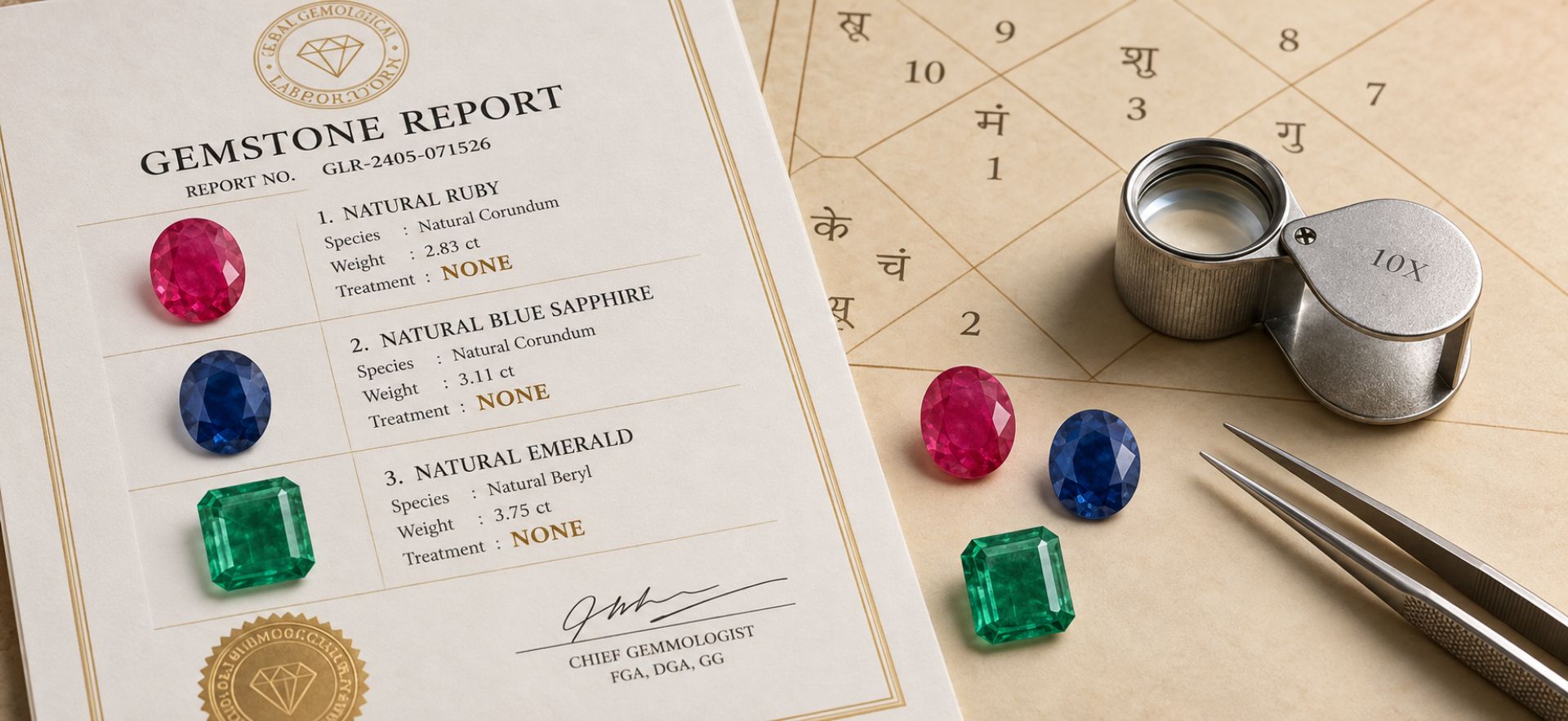
In Jyotish astrology, gemstones must be natural and untreated, and the certificate’s treatment disclosure is the most important proof of that purity. Emeralds are the only exception, since minor colourless oiling is traditionally accepted as preservation. Certificates provide independent documentation, but because detection has limits, the final assurance comes from the gemologist who sources the stone and guarantees its integrity.
In Vedic Astrology (Jyotish), gemstones are not regarded as mere ornaments. They are instead understood as cosmic conduits that transmit and amplify planetary energies directly into the wearer’s body. Because gemstones play this sacred role, the requirements for a Jyotish‑quality gemstone are exceptionally strict.
The stone must be natural and free from enhancements such as heating, filling, diffusion, or dyeing. A glass‑filled Ruby or a diffusion‑treated Blue Sapphire, no matter how dazzling, cannot serve its astrological purpose.
Authentication through an independent laboratory certificate is therefore non‑negotiable. Among all the details on a report, the treatment disclosure line is the most critical, as it determines whether the gemstone truly meets Jyotish standards of purity and integrity. The only exception is emeralds.
For these reasons, Jyotish tradition treats Emeralds differently from other gemstones. Colourless oiling is considered preservation rather than enhancement, and laboratories such as GIA, GRS, and Swiss institutions report the level of oiling as none, insignificant, minor, moderate, or significant. Only minor or insignificant colourless oiling is acceptable for astrology, while dyed fillers or resin treatments are not. Since nearly all Emeralds are oiled, certificates for average‑grade stones may not even mention it, making careful evaluation essential – especially in markets like the UAE where astrological gemstones are widely purchased.
For Jyotish gemstones, certification is not about resale or insurance but spiritual integrity. They matter beyond their value because:
“A certificate confirms what can be detected, but in Jyotish it protects the gemstone’s spiritual integrity .” – Darshan Shah, Gemmologist.
For Jyotish gemstones such as Blue Sapphire, Yellow Sapphire, Ruby, Hessonite, and Cat’s Eye, purity is essential. Any treatment, even heating, makes the stone unsuitable for astrological use, no matter how attractive it may look.
Certificates provide independent documentation, but they are only part of the assurance. The final safeguard comes from a trusted gemmologist, whose expertise ensures the stone’s integrity. Even with a valid certificate in the UAE or elsewhere, expert sourcing remains vital. You need to note that certificates confirm just the facts, and a gemmologist, he or she protects the gemstone’s true astrological quality.
The truth most buyers rarely hear is that even the best laboratories can only report fillers when they are detectable. A certificate may clearly state “colourless oil,” “artificial resin,” or “dyed filler” when evidence is present. But when detection is inconclusive, the report may remain silent.
This silence is not a failure of the laboratory and it reflects the limits of current testing technology. Certificates provide the strongest independent documentation available, but they cannot guarantee absolute certainty. For Jyotish gemstones, that certainty depends on the gemmologist who sources the stone and upholds its integrity.
At N Gopaldaas Jewellers, for example, only colourless oil is applied to Emeralds intended for astrology. This is a sourcing commitment built on trust, something no certificate alone can guarantee.
When selecting a laboratory for astrological gemstones, you need to think about the following.
For everyday astrological gemstones, certification from DCL Dubai, IGTL Jaipur, GII Mumbai, or Pangem Pune is sufficient. For exceptional stones, insist on GRS, Gübelin, or SSEF.
Colourless oiling traditionally uses cedar wood oil; it fills fractures without altering colour. It is accepted in Jyotish. Resin treatments, such as Opticon, are synthetic fillers and are not acceptable for astrological purposes.
Yes, if the oil is colourless. Minor or insignificant colourless oiling is considered acceptable. Dyed or resin fillers are not.
Silence means detection was inconclusive. This is a limitation of technology, not negligence. In such cases, rely on your gemmologist’s sourcing assurance.
For standard astrological stones: DCL Dubai, IGTL Jaipur, GII Mumbai, or Pangem Pune. For high‑value stones: GRS, Gübelin, or SSEF.
We have covered the philosophy and the triggers. Now for the practical tools. Below is an honest overview of some of the main laboratories your certificate might come from — what each one is genuinely good at, and where it sits in the overall picture. Below this list is a reference guide to help determine certificates you can request/expect when buying a particular stone.
| Lab | Specialises In | What Makes It Relevant | Location | Authority Level |
| GIA | Diamonds | Gold standard for diamonds. Origin reports for coloured stones on select high-value pieces only. | International | High |
| IGI | Diamonds + coloured stones | Widely accepted in UAE and India. Practical for mid-range diamonds. | Dubai lab available | Moderate |
| HRD | Diamonds + coloured stones | Belgian institute. Credible and widely accepted in Europe, India and the UAE. Good for diamonds and standard coloured stones. | International | Moderate–High |
| GRS | Coloured stones only | Pioneered ‘Pigeon Blood’ and ‘Royal Blue’ colour grades. Preferred by auction houses. | International | High |
| Gübelin Gem Lab | Coloured stones + diamonds | Most respected for origin determination on high-value coloured stones. | International | Very High |
| SSEF | Coloured stones | Particularly strong for emerald origin. Preferred by European collectors. | International | High |
| DCL Dubai | Diamonds + coloured stones | Government-backed. ISO-accredited. Legally recognised in the UAE. | Dubai | Good for the UAE market |
| IGTL Jaipur | Coloured stones + diamonds | Reputable Indian lab. Reliable for identification and treatment disclosure. | India | Good for the India–UAE market |
| GII Mumbai | Coloured stones + diamonds | One of India’s oldest gemological institutions. Well regarded across India and the Gulf. | India | Good for the India–UAE market |
| Pangem, Pune | Coloured stones | Respected Indian lab. One of the few that photographs inclusions directly on the certificate — a unique identity record for the stone. | India | Good for the India–UAE market |
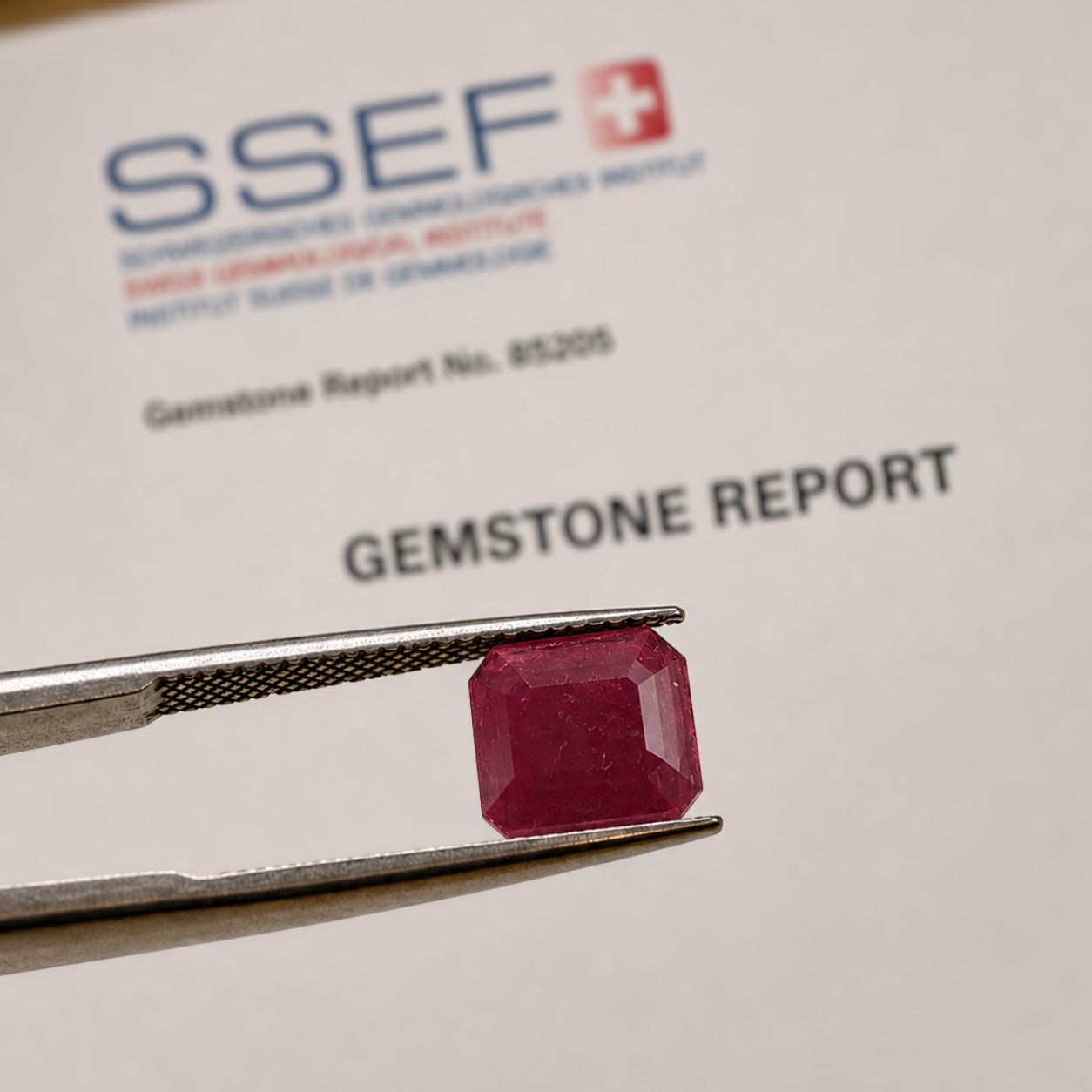
Use this as your reference guide before any significant gemstone purchase. However, we recommend connecting with us to ensure the credibility of a specific laboratory for a certain precious stone. Do reach out to us to verify and validate before your purchase.
| Stone Type and Situation | Recommended Certificate | Why |
| Astrological gemstone (Neelam, Pukhraj, Panna, Manik) — standard quality | DCL Dubai, IGTL Jaipur, GII Mumbai, or Pangem Pune | Confirms natural identity and treatment status. Proportionate to purpose and value. |
| Diamond — any value | GIA, IGI, or HRD | GIA for high-value. IGI and HRD widely accepted in UAE and India for mid-range. |
| Coloured stone — good quality, typical origin, standard colour | DCL Dubai, IGTL, GII, or IGI | Sufficient for identification, treatment disclosure, and buyer confidence. However, for higher value coloured gemstones, you may need specific certifications, like those mentioned below. |
| Natural Blue Sapphire — Royal Blue or Cornflower Blue colour grade | GRS or Gübelin | The colour grade on the certificate materially affects the value of the stone. |
| Natural Ruby — Pigeon Blood colour, possible Burmese origin | GRS or Gübelin | Origin and colour grade together determine the premium. Both must be documented. |
| Colombian Emerald — no treatment or minimal treatment | GRS, Gübelin or SSEF | Untreated Colombian emerald is rare. A credible certificate protects and proves that rarity. |
| Kashmir Sapphire — any quality | GRS, Gübelin or SSEF | Kashmir origin alone commands a significant premium. Must be verified by a top-tier laboratory. |
| Any exceptional stone — auction, inheritance or investment purchase | GRS, Gübelin or SSEF | The more irreplaceable the stone, the more important the documentation. |
If you are buying a gemstone for astrological purposes in the range most buyers operate in, a certificate from the Dubai Central Laboratory, IGTL Jaipur, GII Mumbai, or Pangem Pune is not a compromise. It is the right document for that purchase. It confirms what you need confirmed, it protects your ownership, and it does not cost more than the stone it accompanies.
This is the core answer to which gemstone certificate do I need in everyday buying situations.
If you are buying a stone that is exceptional in its category — exceptional colour, exceptional origin, exceptional treatment status — then the certificate matters more. Not because the stone is expensive, but because the certificate is the only thing that verifiably distinguishes it from a similar-looking stone that is not exceptional. In that case, the additional cost of a Swiss or GIA certificate is not overhead. It is part of what you are buying. Moreover, many sellers often provide more than one certificate for the same stone when it is an exceptionally rare gemstone that is under consideration.
The difference between these two situations is not always obvious to a buyer walking into a store. It is obvious to a gemologist who has been handling stones for 30 years. Which is exactly why the conversation matters.

For diamonds, GIA is the most widely respected globally. IGI and HRD are credible and widely accepted in the UAE and India — often more practical for mid-range diamonds due to faster turnaround and lower cost. For coloured gemstones, none of the three is the first choice — the Swiss labs (GRS, Gübelin, SSEF) carry more weight for high-value coloured stones. However, when dealing in exceptionally rare stones, one may be provided more than one certificate to confirm authenticity.
Yes — within its scope. A Gemstone certificate in Dubai issued by the Dubai Central Laboratory is ISO-accredited, government-backed, and legally recognised under UAE federal law. It is credible for routine gemstone identification and treatment disclosure, comparable to reputable Indian laboratories. It is not a global colour-grading authority for exceptional stones, but for the majority of purchases in the Dubai market it is entirely fit for purpose.
Because an untreated or minimally treated Colombian Emerald is exceptional within a category where treatment is the global norm. That rarity has real value — but only if it is verified by a laboratory whose treatment disclosure methodology the market trusts. A high-level certificate in this case is not about the price of the stone. It is about documenting something genuinely rare. In such cases, determining which gemstone certificate do you need becomes critical, and a basic report is not sufficient.
Yes. The Dubai Central Laboratory offers certification services for diamonds and coloured gemstones. IGI also has a laboratory in Dubai. For stones requiring Swiss-level certification, the stone would need to be sent abroad, which takes additional time and cost. At N Gopaldaas Jewellers we can advise you on the appropriate certificate for your specific stone and purchase.
Both are reputable Indian gemological institutions. GII (Gemological Institute of India) is one of India's oldest, based in Mumbai. IGTL is based in Jaipur — the heart of India's coloured gemstone trade. Both are credible for identification and treatment disclosure for astrological gemstone purchases.
Pangem is a respected Indian laboratory with strong credibility in the India–Gulf market. It is one of the few laboratories that photographs inclusions directly on the certificate, providing an additional layer of stone identity documentation — particularly valuable for astrological gemstones, where the stone's identity over time matters as much as its initial quality.
