
Summary: This article reviews the importance of gemstone certificates in Dubai. It covers the physical attributes identified in a report, laboratory and regulatory considerations in Dubai, the risks of unpapered gems, and a verification routine for a gemstone certificate.
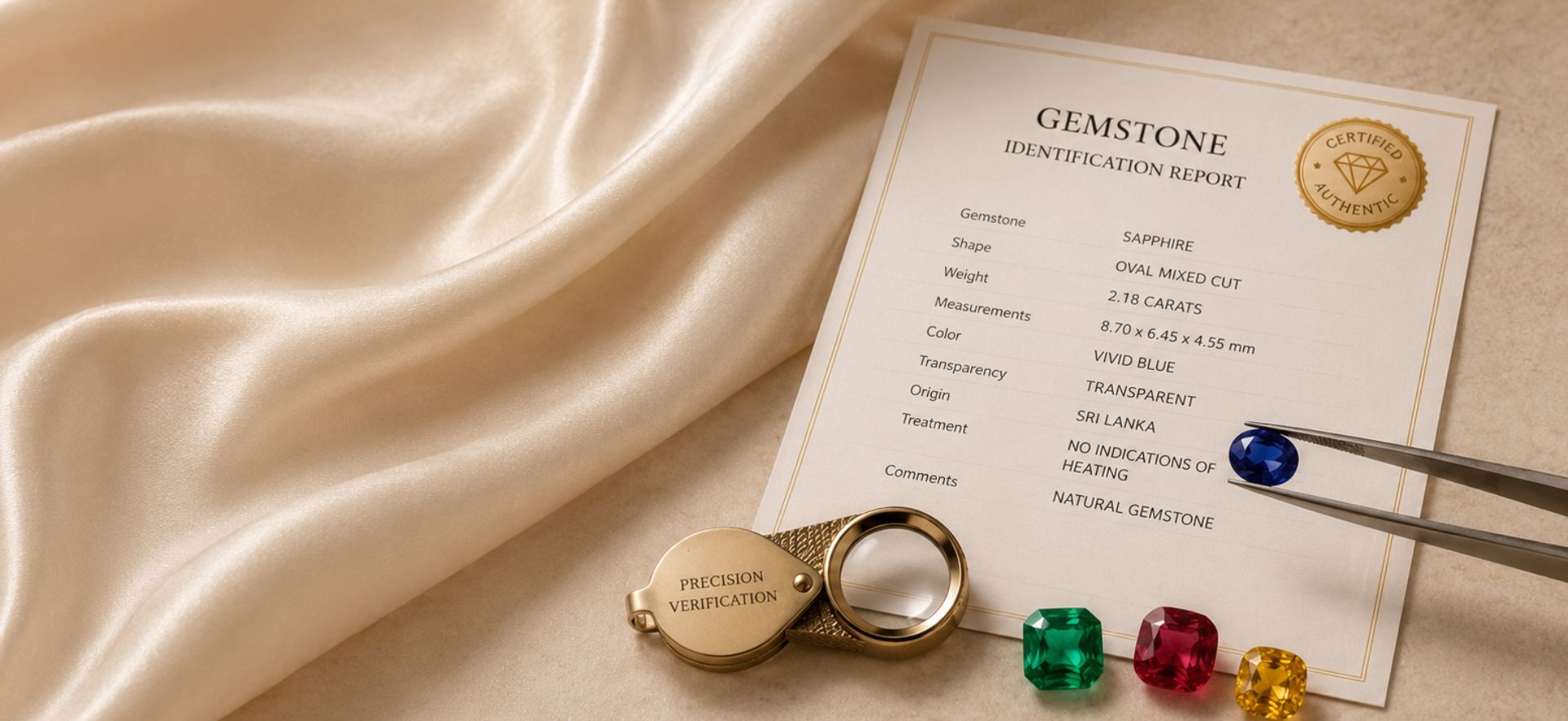
A gemstone certificate, or gemological report, is a scientific assessment of a mineral conducted by qualified gemologists.
It is not a sales receipt, which signifies a buyer’s agreement to terms and receipt of funds. It is also distinct from an insurance appraisal, which estimates monetary value for replacement. A laboratory assessment is a document that records a mineral’s properties.
Dubai is a major international marketplace for diamonds, gold, and colored minerals. Independent certificate evaluation facilitates legitimate dealings in precious wares in the emirate.
At the point of sale, seller bias is eliminated. A mineral acquires a permanent identity that can be used for insurance and legal documentation. Pricing becomes more rational, and some laboratories go further by printing or painting a gem’s unique characteristics onto the paper so that the stone carries its fingerprint.
Highlight:
A gemstone certificate does not replace a sales receipt or insurance appraisal. It provides an independent, scientific identity for the stone.
Matching the Certificate to the Stone: Proportionate Certification
A lab document should be matched to a specific stone. Proportionate certification means the extent of examination is commensurate with a mineral’s grading.
| Gemstone Value | Recommended Certification |
| Low-Cost Mineral | Requires only an identification report. |
| Expensive Gemstone | Requires full disclosure of treatments and internal features such as inclusions. |
Dubai has policies and infrastructure to provide laboratory appraisal.
Launched by: Dubai Metals and Commodities Centre (DMCC).
Certification: An ISO-certified inspection and testing centre for diamonds, gemstones, pearls, and jewellery.
Mandate: To standardise global commerce practices, promote ethical trading, and boost consumer confidence in the emirate’s jewellery industry.
Infographic Placeholder:
[Infographic: Dubai gemstone certification ecosystem — DCL, DGC, DMCC, and sample transport rules]
Unverified sellers and a lack of documentation pose several risks. Synthetic, treated, or altered material is passed off as natural.
Danger Box: The Dangers of Buying Uncertified Gems
Undisclosed Treatments: Heat treatment, plastic cavity filling, or fissure filling may not be revealed.
Financial Roadblocks: Banks, jewellers, and secondary buyers may refuse buybacks, trade-ins, or collateral if the gemstone is not independently regraded.
Legal Trouble: When hallmarking or a certificate attesting to origin is missing, legal penalties may apply under regional trade laws.
No After-Sales Support: Warranty, return policy, after-sales valuation, and repair support may be unavailable.
A four-step process enables a gem buyer to verify that a certificate is authentic and attached to the appropriate stone.
1.Check the Report Number: The buyer checks the unique report number printed on the physical certificate.
2.Cross-Reference the Inscription: Under 10x magnification, the buyer cross-references the girdle laser inscription on the gemstone or diamond with the document.
3.Verify Online: The buyer visits the laboratory’s website or online portal to view the digital version of the report. They use the report number and carat weight to access the database, then cross-reference it with the physical document’s specifications such as weight, size, colour, and clarity.
4.Inspect Security Features: The buyer inspects the paper report for anti-counterfeiting features such as holograms, watermarks, and security screens.
Dubai gemstone certification offers more than regulatory compliance with paperwork. It creates a forensic audit trail for a mineral. Certification informs the owner of what they have purchased and serves as a basis for redress in case of a dispute. The combination of Dubai’s laboratory infrastructure, regulatory framework, and a careful verification routine transforms a risky purchase into an authenticated and documented transaction.
A DCL certificate is the official gemological report issued by Dubai Central Laboratory in Karama. DCL uses specialised laser technology to identify artificial treatments, such as thermal heat enhancement or plastic-doctored cavities in amber. The official certificate provides a cost-effective alternative to a scientifically proven gemological report that attests to the natural quality of a given stone.
Dubai Gem Certification (DGC) is an ISO-certified service provided by Dubai Metals and Commodities Centre (DMCC). It enables regional traders and buyers to certify gemstones within the city’s geographical borders under international standards, with a number of official laboratories, including AGSL and Switzerland’s Gübelin Gem Laboratory.
By virtue of Administrative Resolution No. (101) of 2019, Dubai Municipality strictly regulates the transport of testing samples between commercial jewellery establishments and Dubai Central Laboratory. The official sample-transport service charges AED 150 per one-way trip. Licensed shops are obligated by law to deliver the requested sample for testing to DCL within three working days.
For commercial and astrological gemstones in the AED 1,000 to AED 3,000 range, shipping a stone abroad and waiting for verification results takes several weeks and can be highly expensive, sometimes costing as much as the stone itself. The local counterpart (DCL, IDL, IGI) is a cost-effective alternative with proportionate expenses and reliable attestation of a gemstone’s authenticity.
First, locate the report number either printed on the certificate or laser-engraved on the gemstone’s girdle. Next, use the online verification tool by entering the code at your convenience on the official website of a gemological lab, such as DCL or IGI. Finally, cross-reference the data by checking that the online records of the gemstone’s carat weight, millimetre circumference, colour, and cut correspond line by line with your certificate. Also check the physical document for security markings, such as a hologram, watermark, or other security feature.
We have covered the philosophy and the triggers. Now for the practical tools. Below is an honest overview of some of the main laboratories your certificate might come from — what each one is genuinely good at, and where it sits in the overall picture. Below this list is a reference guide to help determine certificates you can request/expect when buying a particular stone.
| Lab | Specialises In | What Makes It Relevant | Location | Authority Level |
| GIA | Diamonds | Gold standard for diamonds. Origin reports for coloured stones on select high-value pieces only. | International | High |
| IGI | Diamonds + coloured stones | Widely accepted in UAE and India. Practical for mid-range diamonds. | Dubai lab available | Moderate |
| HRD | Diamonds + coloured stones | Belgian institute. Credible and widely accepted in Europe, India and the UAE. Good for diamonds and standard coloured stones. | International | Moderate–High |
| GRS | Coloured stones only | Pioneered ‘Pigeon Blood’ and ‘Royal Blue’ colour grades. Preferred by auction houses. | International | High |
| Gübelin Gem Lab | Coloured stones + diamonds | Most respected for origin determination on high-value coloured stones. | International | Very High |
| SSEF | Coloured stones | Particularly strong for emerald origin. Preferred by European collectors. | International | High |
| DCL Dubai | Diamonds + coloured stones | Government-backed. ISO-accredited. Legally recognised in the UAE. | Dubai | Good for the UAE market |
| IGTL Jaipur | Coloured stones + diamonds | Reputable Indian lab. Reliable for identification and treatment disclosure. | India | Good for the India–UAE market |
| GII Mumbai | Coloured stones + diamonds | One of India’s oldest gemological institutions. Well regarded across India and the Gulf. | India | Good for the India–UAE market |
| Pangem, Pune | Coloured stones | Respected Indian lab. One of the few that photographs inclusions directly on the certificate — a unique identity record for the stone. | India | Good for the India–UAE market |
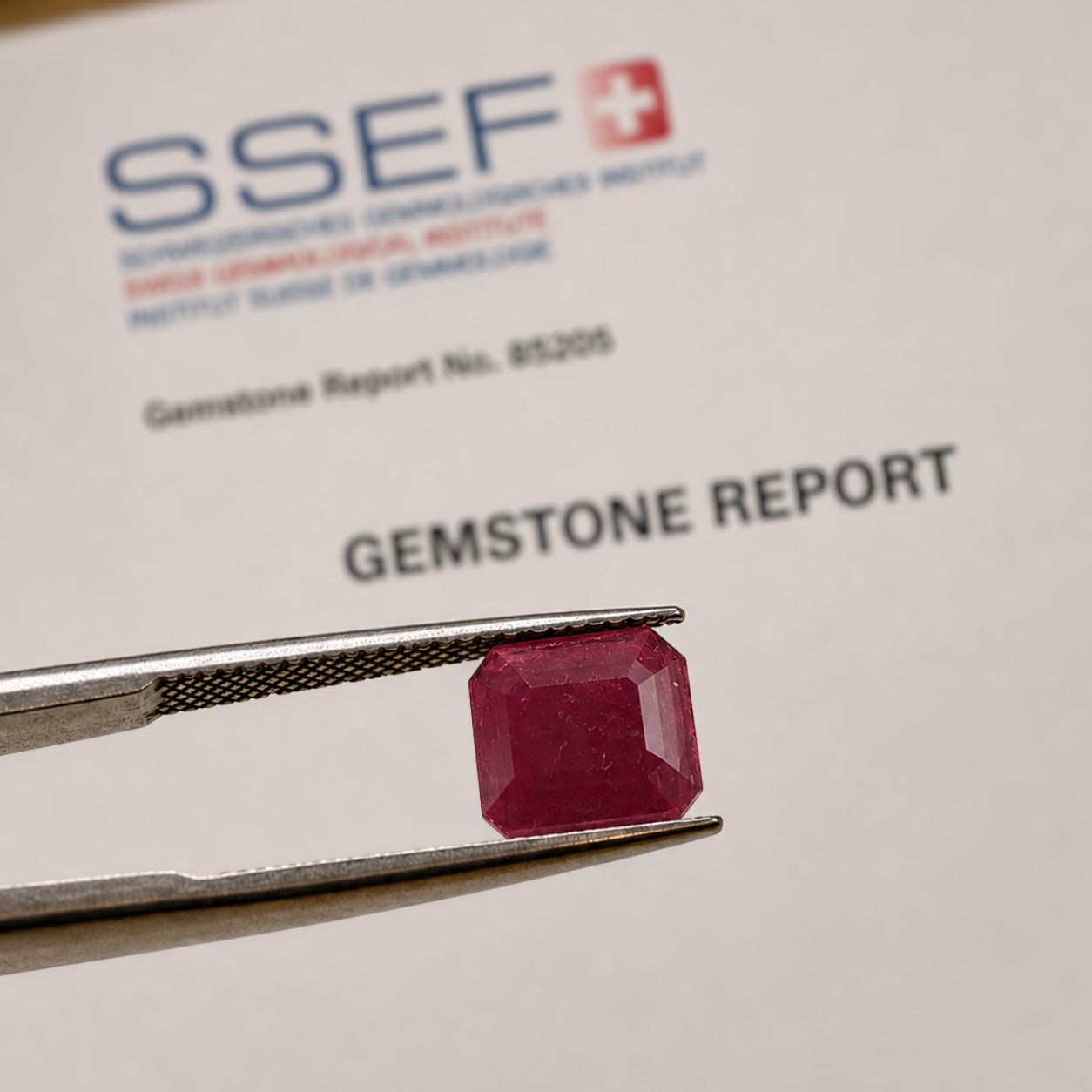
Use this as your reference guide before any significant gemstone purchase. However, we recommend connecting with us to ensure the credibility of a specific laboratory for a certain precious stone. Do reach out to us to verify and validate before your purchase.
| Stone Type and Situation | Recommended Certificate | Why |
| Astrological gemstone (Neelam, Pukhraj, Panna, Manik) — standard quality | DCL Dubai, IGTL Jaipur, GII Mumbai, or Pangem Pune | Confirms natural identity and treatment status. Proportionate to purpose and value. |
| Diamond — any value | GIA, IGI, or HRD | GIA for high-value. IGI and HRD widely accepted in UAE and India for mid-range. |
| Coloured stone — good quality, typical origin, standard colour | DCL Dubai, IGTL, GII, or IGI | Sufficient for identification, treatment disclosure, and buyer confidence. However, for higher value coloured gemstones, you may need specific certifications, like those mentioned below. |
| Natural Blue Sapphire — Royal Blue or Cornflower Blue colour grade | GRS or Gübelin | The colour grade on the certificate materially affects the value of the stone. |
| Natural Ruby — Pigeon Blood colour, possible Burmese origin | GRS or Gübelin | Origin and colour grade together determine the premium. Both must be documented. |
| Colombian Emerald — no treatment or minimal treatment | GRS, Gübelin or SSEF | Untreated Colombian emerald is rare. A credible certificate protects and proves that rarity. |
| Kashmir Sapphire — any quality | GRS, Gübelin or SSEF | Kashmir origin alone commands a significant premium. Must be verified by a top-tier laboratory. |
| Any exceptional stone — auction, inheritance or investment purchase | GRS, Gübelin or SSEF | The more irreplaceable the stone, the more important the documentation. |
If you are buying a gemstone for astrological purposes in the range most buyers operate in, a certificate from the Dubai Central Laboratory, IGTL Jaipur, GII Mumbai, or Pangem Pune is not a compromise. It is the right document for that purchase. It confirms what you need confirmed, it protects your ownership, and it does not cost more than the stone it accompanies.
This is the core answer to which gemstone certificate do I need in everyday buying situations.
If you are buying a stone that is exceptional in its category — exceptional colour, exceptional origin, exceptional treatment status — then the certificate matters more. Not because the stone is expensive, but because the certificate is the only thing that verifiably distinguishes it from a similar-looking stone that is not exceptional. In that case, the additional cost of a Swiss or GIA certificate is not overhead. It is part of what you are buying. Moreover, many sellers often provide more than one certificate for the same stone when it is an exceptionally rare gemstone that is under consideration.
The difference between these two situations is not always obvious to a buyer walking into a store. It is obvious to a gemologist who has been handling stones for 30 years. Which is exactly why the conversation matters.

For diamonds, GIA is the most widely respected globally. IGI and HRD are credible and widely accepted in the UAE and India — often more practical for mid-range diamonds due to faster turnaround and lower cost. For coloured gemstones, none of the three is the first choice — the Swiss labs (GRS, Gübelin, SSEF) carry more weight for high-value coloured stones. However, when dealing in exceptionally rare stones, one may be provided more than one certificate to confirm authenticity.
Yes — within its scope. A Gemstone certificate in Dubai issued by the Dubai Central Laboratory is ISO-accredited, government-backed, and legally recognised under UAE federal law. It is credible for routine gemstone identification and treatment disclosure, comparable to reputable Indian laboratories. It is not a global colour-grading authority for exceptional stones, but for the majority of purchases in the Dubai market it is entirely fit for purpose.
Because an untreated or minimally treated Colombian Emerald is exceptional within a category where treatment is the global norm. That rarity has real value — but only if it is verified by a laboratory whose treatment disclosure methodology the market trusts. A high-level certificate in this case is not about the price of the stone. It is about documenting something genuinely rare. In such cases, determining which gemstone certificate do you need becomes critical, and a basic report is not sufficient.
Yes. The Dubai Central Laboratory offers certification services for diamonds and coloured gemstones. IGI also has a laboratory in Dubai. For stones requiring Swiss-level certification, the stone would need to be sent abroad, which takes additional time and cost. At N Gopaldaas Jewellers we can advise you on the appropriate certificate for your specific stone and purchase.
Both are reputable Indian gemological institutions. GII (Gemological Institute of India) is one of India's oldest, based in Mumbai. IGTL is based in Jaipur — the heart of India's coloured gemstone trade. Both are credible for identification and treatment disclosure for astrological gemstone purchases.
Pangem is a respected Indian laboratory with strong credibility in the India–Gulf market. It is one of the few laboratories that photographs inclusions directly on the certificate, providing an additional layer of stone identity documentation — particularly valuable for astrological gemstones, where the stone's identity over time matters as much as its initial quality.
