


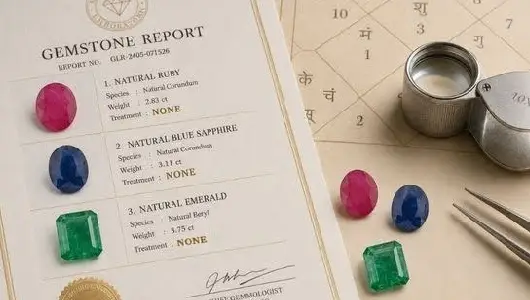
The Jyotish tradition is clear: treated stones are not acceptable for astrological purposes. The certificate’s treatment disclosure is the single most critical piece of information for an astrological gemstone buyer.
But there is a known limitation — even the finest laboratories in the world cannot always fully resolve it. Every astrological gemstone buyer should understand what it is.
Parts 1 and 2 covered the philosophy and the three triggers. This part goes deeper into astrological gemstones specifically — because for Jyotish purposes, the certificate’s role is not just about value. It is about the integrity of the stone itself
What the Jyotish tradition requires for untreated gemstones for astrology
The tradition is clear: for a gemstone to fulfil its astrological purpose, it must be natural and untreated. A glass filled Ruby or diffusion-treated Blue Sapphire, however beautiful, is not a Jyotish-quality stone. The certificate’s treatment disclosure is therefore not a formality — it is the most important line on the document.
In fact, when evaluating untreated gemstones for astrology, the treatment line on a certificate becomes more important than origin, colour, or even carat weight.
The one accepted exception: the Emerald
Emerald the stone of Mercury is the exception. Emeralds are heat-sensitive and brittle by nature. Oiling has been practised for centuries as a preservation measure, and colourless oiling is accepted within the Jyotish tradition. It maintains the stone’s structural integrity without altering its colour or its energy. It is a preservative practice, not an enhancement.
High Value certificates like the GIA, GRS or any other Swiss lab, comments on the degree of oiling none, insignificant, minor, moderate, or significant and if the Oil is coloured or colourless minor and insignificant, colourless, are generally considered acceptable for astrological purposes. For average grade of Emeralds, oiling is generally not mentioned in the certificates as they are 99% oiled albeit colourless. For buyers relying on an astrological gemstone certificate in the UAE, this distinction becomes especially important when evaluating Emeralds.
The limitation every buyer should know
Here is what most buyers are never told: even the finest laboratories in the world comment on the type of filler in an Emerald only when it is detectable. A report may state ‘colourless oil,’ ‘artificial resin,’ or ‘dyed filler’ when the evidence is clear. But when detection is inconclusive, the report may simply remain silent on the nature of the filler.
This is not a failure of the laboratory. It is a genuine limitation of current detection technology. It means that for untreated gemstones for astrology, the certificate gives you the best available independent documentation — but not absolute certainty in every case, as it rests with the gemologist who sourced the stone and who can speak to the treatment practice of the supplier they work with.
At N Gopaldaas Jewellers, we ensure that only colourless oil is applied to the Emeralds we source for astrological purposes. That is a commitment we carry — not one a certificate can make on our behalf.
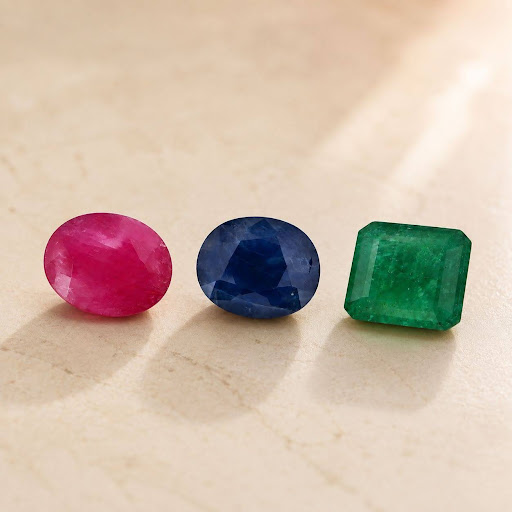
Why Untreated Gemstones for Astrology Require Strict Verification
For all other astrological gemstones — Blue Sapphire, Yellow Sapphire, Ruby, Hessonite, Cat’s Eye — no treatment of any kind is acceptable. A heated Blue Sapphire or Ruby, however beautiful, is not a Jyotish-quality stone. A certificate is the best available independent documentation. But for untreated gemstones for astrology, the relationship with your gemologist becomes the final layer of assurance. Even with a valid astrological gemstone certificate UAE, expert sourcing remains essential.
A certificate is the best available independent documentation. The relationship with your gemologist is the final layer of assurance.
Part 4 — the final part — gives you the practical tools: an honest overview of the main laboratories, what each one is genuinely good at, and a stone-by-stone reference guide to use before any significant gemstone purchase.
Which gemstone certificate do I need? A Practical Laboratory Guide
Quick Summary Parts 1 to 3 covered the philosophy, the three triggers, and what the Jyotish tradition requires. This final part gives you the
What Makes a Stone Require a High Value Gemstone Certificate
Quick Summary The decision to invest in a high-level certificate is never about price alone. It is about three specific qualities, any one of which,
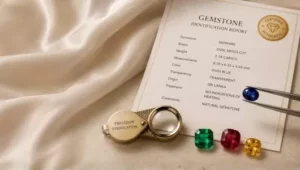
Gemstone Certificate Dubai: Why the Right Certificate Matters
Quick Summary Not every gemstone needs a GIA or Swiss lab certificate. The right certificate depends not only on the price of the stone but
Astrologer vs Gemologist: Do You Need Both for Buying Gemstones?
Quick Summary An astrologer tells us which gemstone to wear based on our birth chart and planetary period, while a gemologist verifies whether that stone