


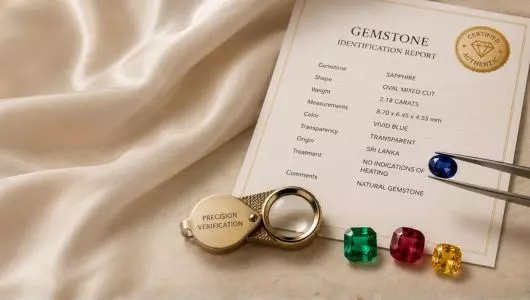
Not every gemstone needs a GIA or Swiss lab certificate. The right certificate depends not only on the price of the stone but also on its rarity, specific qualities, and the purpose of the purchase. Most buyers walk in asking for the most prestigious name they know. That is the wrong question. The right one is: what does this particular stone actually need confirmed?
The Certificate Should Fit the Stone: Choosing the Right Gemstone Certificate in Dubai
A gemstone certificate is not a status symbol. It is a practical document, and like any practical document, its value depends entirely on whether it is the right one for the job, especially in markets like Dubai, where buyers are often exposed to multiple international grading systems.
There is a widespread assumption among buyers that a Gemological Institute of America (GIA) or International Gemological Institute (IGI) certificate is the only mark of a trustworthy purchase. I understand where this comes from. GIA is the most recognised name in gemology. IGI and HRD too have significant presence in India and the UAE. All are credible institutions.
But here is what most people do not know: a GIA certificate for a coloured gemstone can cost more than the stone itself. It takes weeks. And for a stone being purchased for astrological purposes – a Neelam (Blue Sapphire), a Pukhraj (Yellow Sapphire), a Panna (Emerald), a Manik (Ruby) – costs in the range most buyers actually spend, but it tells you nothing more than what a certificate from a well-equipped local laboratory, one from the Dubai Central Laboratory (DCL), an IGI certificate, or an International Diamond Laboratories (IDL) certificate would.
Asking for a GIA certificate on an astrological Emerald worth AED 1,500 is not wrong. It is simply disproportionate. And in the gemstone trade, disproportionate certification is a sign that the buyer does not yet have the framework to know what they are asking for.
This series is that framework.
What most buyers ask, and what they should ask instead
A customer walks into our store. Their astrologer has prescribed a Columbian Emerald of a specific weight, specifically for strengthening Mercury. They sit down and, before I have shown them a single piece, they say: “I want one that is GIA or Swiss certified only.”
I take a breath. And then I explain.
A GIA certificate for a coloured gemstone, sent from Dubai, takes several weeks and costs a lot. For an astrological Emerald in the AED 1,000 – AED 3,000 range, the certificate cost would be equal to or exceed the value of the stone itself. In many such cases, a gemstone certificate from DCL, IGI or IDL provides all the necessary confirmations in a far more proportionate way. It confirms that it is a natural Emerald, specifies its approximate quality characteristics, and states whether it is a treated gemstone or not.
The customer is not wrong to want assurance. They are entirely right. What they are asking for is the right answer, but through the wrong instrument.
A credible local or regional certificate is the proportionate answer for that purchase.
A Swiss lab certificate is the answer for a very different kind of stone. Understanding the difference between those two situations is exactly what this series is about in the context of gemstone certificate practices in Dubai.
Why a Gemstone Certificate Matters Beyond Quality
Most buyers think of a certificate as a quality document — proof that a stone is natural, and a record of its characteristics. That is true. But a gemstone certificate does something more important that almost no one thinks about at the time of purchase.A certificate is, in effect, a forensic document. It is an independent scientific record of a specific stone’s identity, created at a specific point in time. And that identity record has uses that extend well beyond the moment of sale.
It can prove ownership:
One of our clients once had their jewellery stolen. The police recovered it, but the question that immediately arose was: how do you prove it is yours? The client produced copies of our certificates. The stone’s weight, measurements, colour characteristics, and treatment status — details that match nothing else in the world. Ownership established.
A receipt records a transaction. A certificate records the stone. In the event of theft, loss, or an insurance claim, it is often the only document that can identify a specific piece as yours.
Some certificates capture a fingerprint:
Every natural gemstone contains inclusions — microscopic features that developed as it formed in the earth. No two stones have identical inclusions. Some laboratories, including the Pangem Testing Laboratory in Pune, feature photographs of these inclusions directly on the certificate.
That photograph becomes a permanent identity record: definitive proof that the stone you hold today is the same stone that was examined and certified. This is not standard practice across all laboratories. Where it is done, it adds a layer of identity verification that description alone cannot provide.
Frequently Asked Questions
1. Do I need a certificate for an astrological gemstone?
Yes. Some form of certification is always advisable, but it does not need to be from a Swiss lab or GIA. A certificate from a credible local or regional laboratory confirming the stone is natural and disclosing any treatments is proportionate and sufficient for most astrological gemstone purchases.2. Is a Gemstone Certificate the same as an appraisal or receipt?
No. A receipt records a transaction — what you paid and when. An appraisal assigns a monetary value, usually for insurance. A certificate documents the stone’s physical identity and characteristics, independently of the seller. In the event of loss, theft, or resale, the certificate proves what the stone actually is and validates its authenticity.3. What is a DCL, IGI, IDL certificate in Dubai?
A DCL certificate refers to a gemstone grading or identification report issued by the Dubai Central Laboratory. It provides verification of a gemstone’s authenticity, natural origin, and treatment status. For most commercial and astrological gemstones, it serves as a practical and cost-effective alternative to high-end international certifications. The IGI certificate is globally recognised and certifies the authenticity, quality, and characteristics of diamonds, coloured gemstones, and finished jewellery. The IDL Certificate is specific to Dubai, providing grading reports for natural, lab-grown, and coloured diamonds.
Which gemstone certificate do I need? A Practical Laboratory Guide
Quick Summary Parts 1 to 3 covered the philosophy, the three triggers, and what the Jyotish tradition requires. This final part gives you the
Untreated Gemstones for Astrology: What a Certificate Must Prove
Quick Summary The Jyotish tradition is clear: treated stones are not acceptable for astrological purposes. The certificate’s treatment disclosure is the single most critical piece
What Makes a Stone Require a High Value Gemstone Certificate
Quick Summary The decision to invest in a high-level certificate is never about price alone. It is about three specific qualities, any one of which,
Astrologer vs Gemologist: Do You Need Both for Buying Gemstones?
Quick Summary An astrologer tells us which gemstone to wear based on our birth chart and planetary period, while a gemologist verifies whether that stone